POST 12/2026/GOSHEN IN . . . Recently we spent time with family and friends in Ontario. Time with the extended Mast family in Michigan. Local events. The Elkhart County 4-H Fair coming up. Welcome to a post a bit longer than usual. Pick and choose as you wish.
Elkhart County Fairgrounds, Goshen, IN
The county 4-H Fair is a biggie, running for nine days, July 24-August1. “Hot” pops to mind. May the best sense of the word “hot” prevail. The fair features much ado about children and youth. Others, too. A parade through the city. Livestock shows. Grandstand concerts. Fair food. Midway rides. Harness racing. Exhibits. Contests. Ribbons. Lots more. There’s something for all ages and interests. A SoftServe ice cream cup is always on our list; though we take a pass from the Tractor Pull and Demolition Derby.
Family/friends, Stratford Festival, Cassel Mennonite Church, Ontario
One week’s sojourn in southern Ontario fed body, mind and soul. Conversations. Meals. A cruise on the Grand River. A bit of shopping. Guys and Dolls and The Hobbit at the Stratford Festival of Canada, surprise meeting at one of the theatres with a group of seven people we know from Goshen, worship at Cassel Mennonite Church.
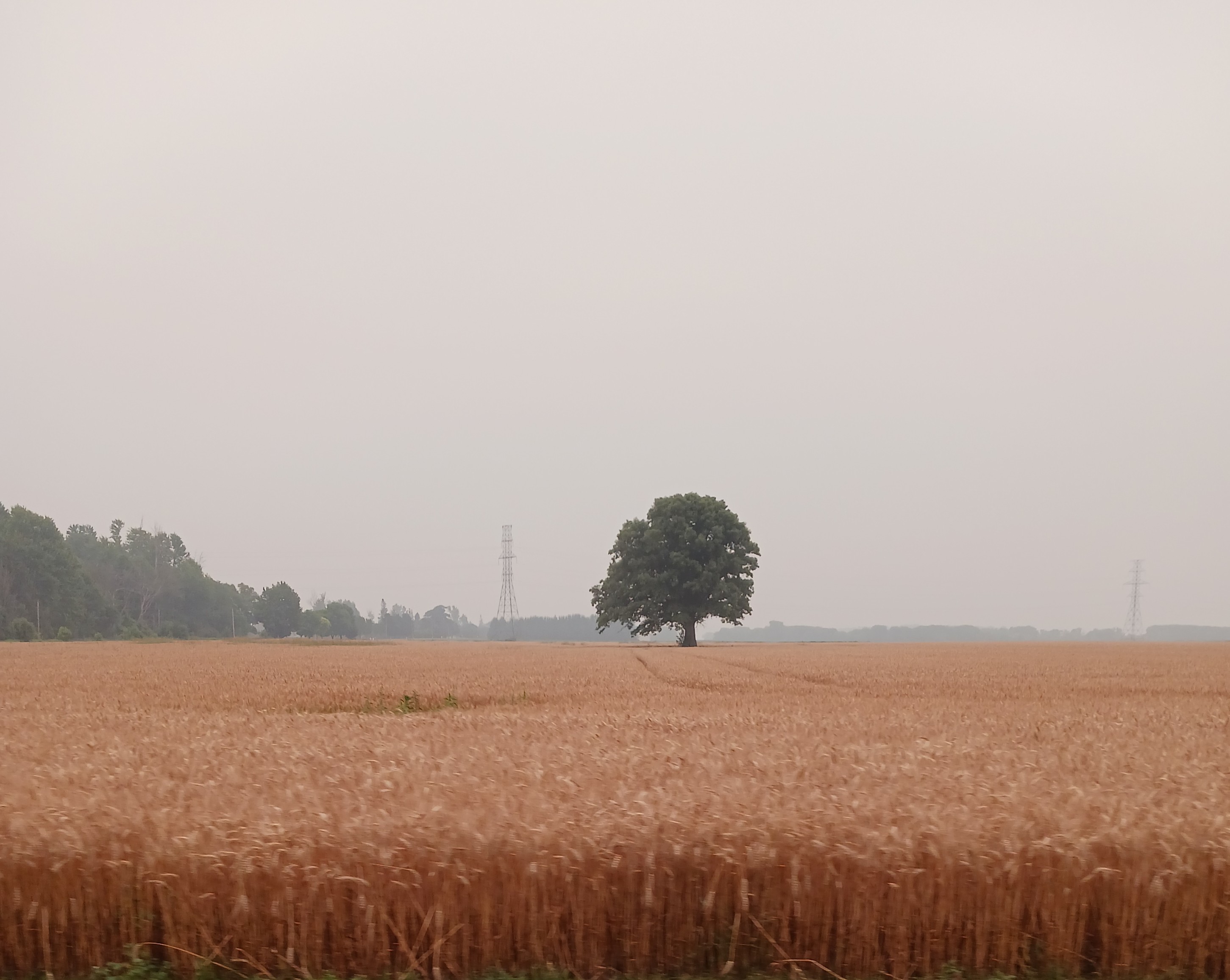
The last two days we faced the effects of the devastating wildfires burning in Manitoba and northern Ontario. Few words can describe the loss people are dealing with as they evacuated from their homes and communities. That Canada and the U.S. have been working cooperatively in fighting fires for four decades gives a positive note. Firefighters in both countries have been there for each other.
On Sunday, July 12, I had the privilege of giving the message at Cassel Mennonite Church, the congregation where I grew up. The biblical text was Matthew 13:1-9, 18-23, the Parable of the Sower. I’ve abbreviated the sermon, removing some family references.
Sermon title: Bushels overflowing
Cassel has been a long-time spiritual home for me. Thank you for receiving us today and through the years. Thanks be to God, who goes before us wherever we go, wherever we move, and wherever we stay put.
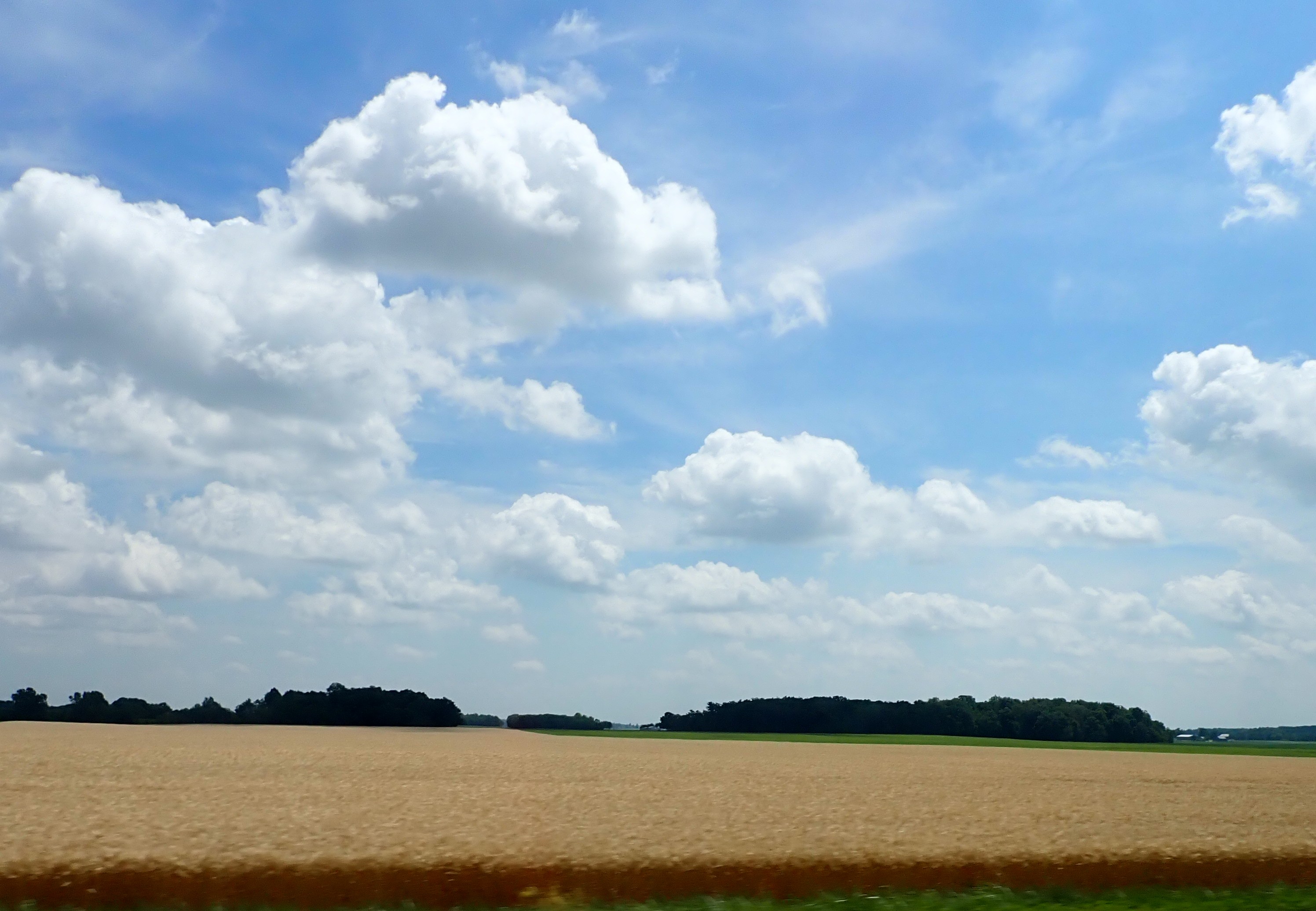
When I see a field of wheat rippling in the breeze, I think of the miracle of growth. Jesus tells the crowd in Matthew 13 that when one seed dies it produces a crop a hundred, sixty, or thirty times what was sown.
Soil, water, sunlight and air allow the plants to create food for themselves, for other living things, and for people. Thanks be to God the Creator for the people at Cassel, past and present, who planted seeds to feed families and the world physically and spiritually.
In the parable from Matthew 13, Jesus shows us how God reveals himself to us through Jesus.
In May, Marty and I returned home from Cornwall in southwest England. In retirement, we’ve spent three months during winter and spring, now 15 times, walking old footpaths and enjoying life with dear friends. We delight in visitors from here, too, like Rachel and once Amy, Sandy and Joy, Mark and Christa and Marty’s family. We are welcomed like family, not tourists. The Cornish call it living “home from home.”
One of our friends is retired Vicar Rev Gorran Chapman, who has been filling in at several Church of England congregations. In his Easter sermon Rev Chapman gave a succinct picture of how God reveals himself to us. To know God, he said, all we have to do is to look at Jesus. To hear the teaching of Jesus is to hear what God wishes us to know. To love and serve Jesus is to love and serve God.
It sounds so straightforward. We see God in Jesus. We hear God in Jesus. We love and serve God in loving and serving Jesus. Easy? No. The secret is a receptive heart.
My message today centers on people through whom God has been revealed to me . . . Whether or not we are or where farmers or grew up on a farm, we know the work, cost, patience–sometimes failures–and wonder involved in preparing the soil, planting, watering and waiting for the sprouts to appear and grow to maturity.
In Matthew 13, Jesus, seated in a boat, tells the crowd that they are like the seeds the Sower scattered.
If they hear what Jesus says about God’s kingdom but are driven away when doubt or distraction appear, then they are like the seed that fell along the hardened path; the evil one comes along and snatches it away.
If they receive the message with joy but their joy falls away quickly when troubles or persecution arise, they are like a seed that falls on rocky ground. They have no root. Their spiritual growth lasts only a short time.
If they hear God’s message but allow it to be choked out by worldly worries, or by pursuing only wealthy gain, or by getting distracted by the material world, they are like a seed that falls on thorny ground. By focusing only on themselves they are living on rocky ground, their lives spiritually unfruitful.
However, if the seed falls on good soil they will hear and understand that they are like a flourishing stalk of grain, producing a spiritual yield a hundred, sixty or thirty-fold.
Jesus invites the crowd to merge their physical and spiritual life by following Jesus, individually and as a body. Jesus invites them to let the seeds God has planted in their hearts grow. Seeds that will produce a bountiful crop, a hundred, sixty or thirty-fold.
How does this apply to Cassel? Think Tractor Breakfast. Community Barbeque in support of Food Grains Canada. Thrift store. Relief Sale. Conference projects. Other local and worldwide ventures. God is using you to nurture the seeds God plants. Since 1935, God’s seeds tended here have produced a bountiful material and spiritual harvest.
I will share two incidents in which my grandmothers nourished these seeds of God’s love and care in my life. I was seven years old, in the second half of the school year, Grade 1. We lived about 3 kilometers east and south of school. My paternal grandparents, Rachel and Solomon, lived on a corner of our farm, an easy walking distance across the field or road from our house to theirs.
My maternal grandparents, Katie and Chris, lived west and south, a bit less than three kilometers from the school. Most often we walked to school.
On the afternoon of April 3, 1950, the weather changed dramatically. A cloudburst washed out the road halfway home from school. Just as school was about to be dismissed, the teacher told me she had gotten word from a Weiker neighbour that I was to go to my grandparents from school and not home.
In my seven-year-old reasoning I figured that the flooded section of the road home meant I should go to my grandparents Chris and Katie. Schumm schoolmates offered me a ride in their pony cart. At the point where they turned north, I got off and walked south to Grandad Chris and Grandmother Katie’s farm.
Grandmother Katie was surprised to see me. I told her about the washout and the phone call that I was supposed to go to my grandparents. Katie phoned Grandma Rachel—it was rare to use the phone, since it cost 10 cents–and told her where I was. Rachel said that Dad and Mom had taken (a younger brother) to town to see the doctor. That’s why I was supposed to stop at their house. At some point I also learned there were people at the flooded road to carry little ones across.
Grandmother Katie said we would have supper when Granddad got home from business in Tavistock and he would take me home in Harold’s Studebaker truck, taking the Cassel sideroad.
Grandmother Katie welcomed me with open arms. She made it seem that our unexpected time together was the best moment of her day.
Grandmother Katie was frail, though we grandchildren hardly noticed it; Mom often helped her out. Two months and five days later, on June 8, on my walk home from school, Grandma Rachel met me at the end of their short drive. I should stay with her, she said. Dad and Mom had gone to be with Grandad Chris. Grandmother Katie had died. Died? I was dumbfounded. How could it be? What happened?
My sky fell in. I sat in the roadside hedge, sobbing, before joining Granny in the kitchen for cookies.
(Grandma Rachel once told me that as part of her daily Bible reading, she prayed for each grandchild by name—all 20 of us.)
Grandmother Katie died of a cerebral hemorrhage; she was a month shy of 59 years old. The newspaper reported that about1000 people came to her memorial service at the East Zorra Amish Mennonite Church. For us children the meal and visitation on the lawn at the farmhouse seemed more like a reunion than a wake. This was the farm where Grandmother had lived, where memories were made, where she held us little spouts in her arms, heart, hands, voice, eyes, and soul. Her spirit stayed and played with us.
The warm embrace of Grandmother Katie on that cloud-burst day, with not one whit of criticism, remains one of my fondest memories, as does the love and care of Grandma Rachel. And of course, many others through whom God sowed seeds in my heart and bones.
Children, like seedlings, need sunshine, water, nutrients, and a safe foundation to reach their full potential. (And regular bedtime.) These young minds are in a constant state of rapid growth and discovery. These little sprouts grow physically, emotionally and mentally as they are rooted and nurtured in good soil.
I hold close the image of Jesus embracing the little children in Matthew 19:13-15. The disciples rebuke the parents, but Jesus tells them to let the little ones come to him. Jesus has patience to see them and bless the seed planted and growing in them.
Matthew 19:13-15. “Then little children were being brought to him in order that he might lay his hands on them and pray. The disciples spoke sternly to those who brought them; but Jesus said, ‘Let the little children come to me, and do not stop them; for it is to such as these that the kingdom of heaven belongs.’ And he laid hands on them and went on his way.”
The ideal characteristics of a child are love, simplicity of faith, innocence, and humility—the same characteristics apply to adults who would enter God’s kingdom. I draw these conclusions of how my grandparents and others helped me and other little sprouts grow.
Mistakes can have a silver lining.
Kindness to a child lasts a lifetime.
While storms can devastate, the sun will shine again.
Joy crowds out sadness.
Love bears fruit.
One question remains: How do we respond, at whatever age, to the spiritual lesson revealed in the Parable of the Sower?
The seed is the Word of God. It falls on the human heart. The condition of the receiver’s heart will determine how well Jesus’ teachings take root and grow. A grandparent may never know how well the seed takes root. They, like all people of faith, prosper and profit not by the harvest they reap but rather by the seeds that they plant.
Let the fruit of the Word of God fill your heart, mind, body and soul, in bushels that overflow. Amen
Christmas in July with Mast family
It has been a tradition for the family and descendants of Doris and Bill Mast to gather for Christmas in July. Marty is a sister of Doris, and we get to enjoy the gathering, too. We fared well, starting out with singing “Joy to the World.”

Around home
We’ve had season tickets at the Wagon Wheel for the Arts in Warsaw, IN, for about 40 years. The Wagon Wheel season features four musicals and one play. On Sunday we saw Dial M for Murder. The director noted that the play is more accurately called a suspense thriller than a murder mystery. “A murder mystery asks the audience, ‘Who did it?’ A suspense thriller asks, ‘What is going to happen next?’ In a mystery, we are trying to solve the crime. In a thriller, we are watching the danger unfold.” We watched and breathed more easily at the end.
We had extra time before the show, so we stopped at the Warsaw Biblical Gardens, a small area that features plants of the Bible. The olive tree below is a striking feature of the gardens.

Home

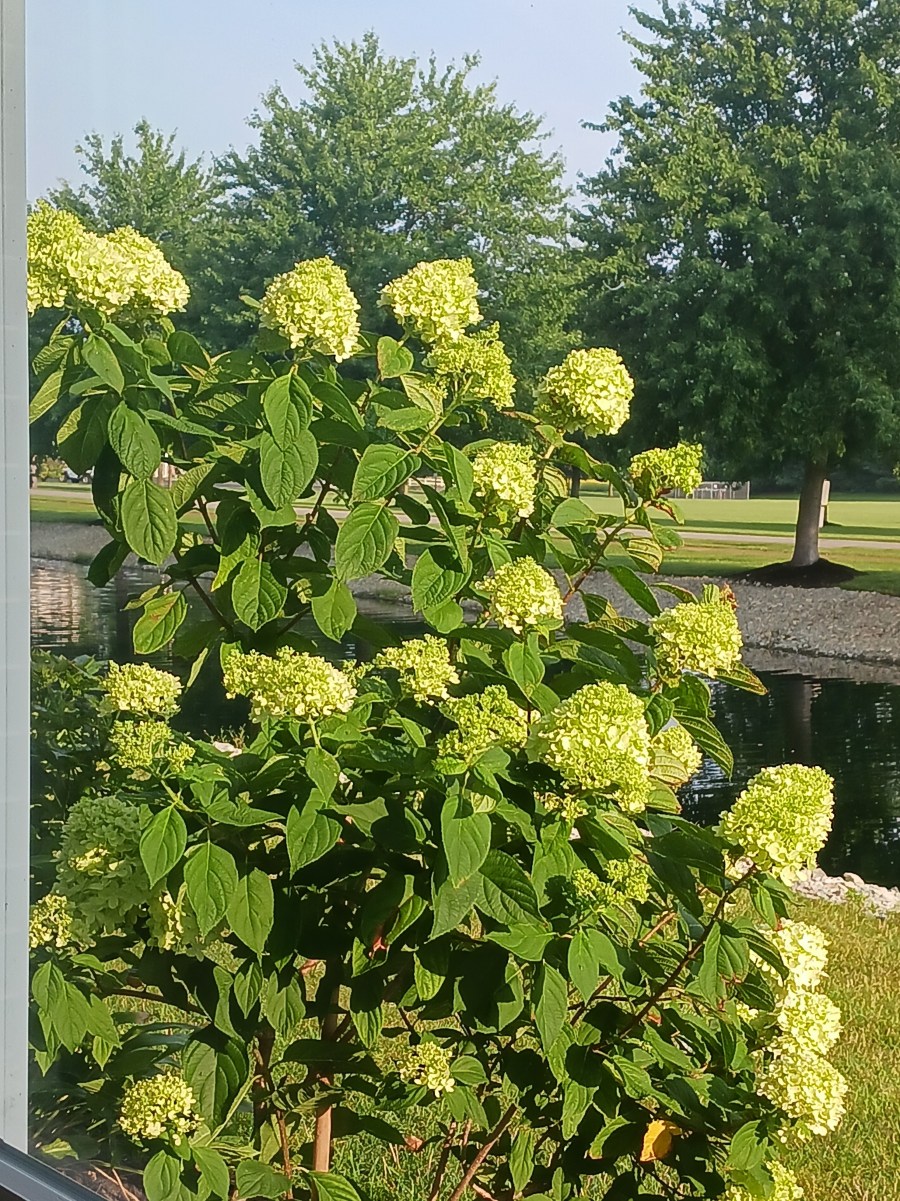
Limelight Hydrangea outside our living room window.

We walked past the Greencroft Goshen Wildflower and Native Grasses area on our way to an off-campus meeting and to pick up a few groceries. Shown is one of the four domestic flowerbeds tended by residents.

Evening sky.
Till next time. Blessings.
–John


Thanks for sharing your sermon reflections — lovely interweaving of scripture and family memories.
We’ve endured one day of smoky skies (fires in Central Oregon), but today the skies are clearer. I hope that means the fires are coming under control.
Summer blessings, Marlene
LikeLike
Thanks, Marlene. It was good to reconnect with the small group at Cassel. The annual tractor breakfast on Saturday brought about 60 vintage tractor aficionados to the fundraiser event for a local charity. The smoke here in Goshen has blown away but the fires burn on. No easy solutions.
All the best in your and Stan’s beings and doings.
John
LikeLike
As always, I enjoyed this blog. I didn’t know your Grandma Katie but I do remember Grandma Rachel. As a child I remember visiting your Grandparents with my parents Willis and Dorothy Bender. I always found it interesting that as well as your Grandma being my Grandma Delila Bender’s sister-in-law (Aaron Bender brother to Solomon) she was also Grandma’s aunt as Rachel was a sister to Grandma’s mother (Magdelena (Iutzi) Ruby. Appreciated your sermon as well – lots of “food for thought”. Carol Roth
LikeLike
Thanks, Carol. Glad for the review of family connections. Thanks, too, for the note of appreciation regarding the sermon. I cut out some of the content for the blog, but the gist was still there. It was so good to be at Cassel.
One note about your dad: Willis helped us out at one threshing time. He did stooking and also operated the binder, dropping the sheaves at given times. Wow, that goes back a long way. Hot, hard work. Good to have done it, though.
All the best! Thanks for writing.
John
LikeLike
Thanks, Carol. Good to hear from you. Good to again see the family connections. Goes back a long time. Your dad helped us with cutting and stooking either the wheat or oats crop. Good memories of how it used to be.
All the best,
John
LikeLike