
Post 3. One gets tired of the nonsense that gets bandied about in the halls of power, especially in this election year. Postering aimed to get attention. Bluster over and over and over to bury inconvenient truths. Noise. Lack of decorum. Neglect of real issues. Rupture. Incivility. Seemingly blind obeisance to strongman disregard for democracy.
All is not lost. Light dispels darkness as one recalls how past struggles led to a new day. Hope lives on.
The Boys in the Boat, by Daniel James Brown, recounts the true story of this team’s unbeaten journey to win gold at the 1936 Olympics. The edition (Viking, Penguin, 2013, 2015) that was available at our library was adapted for young readers.
The rowing team, from the University of Washington, through hard work, grit and almost supernatural effort qualified for the 1936 Olympics in Berlin, Germany. We know that against formidable odds they won Gold. We know they won by six-tenths of a second ahead of the Italian boat and exactly a second ahead of the Germans. Herr Hitler was not amused. We know that such soul-stirring stories inspire our gratitude, resolve and hope today.
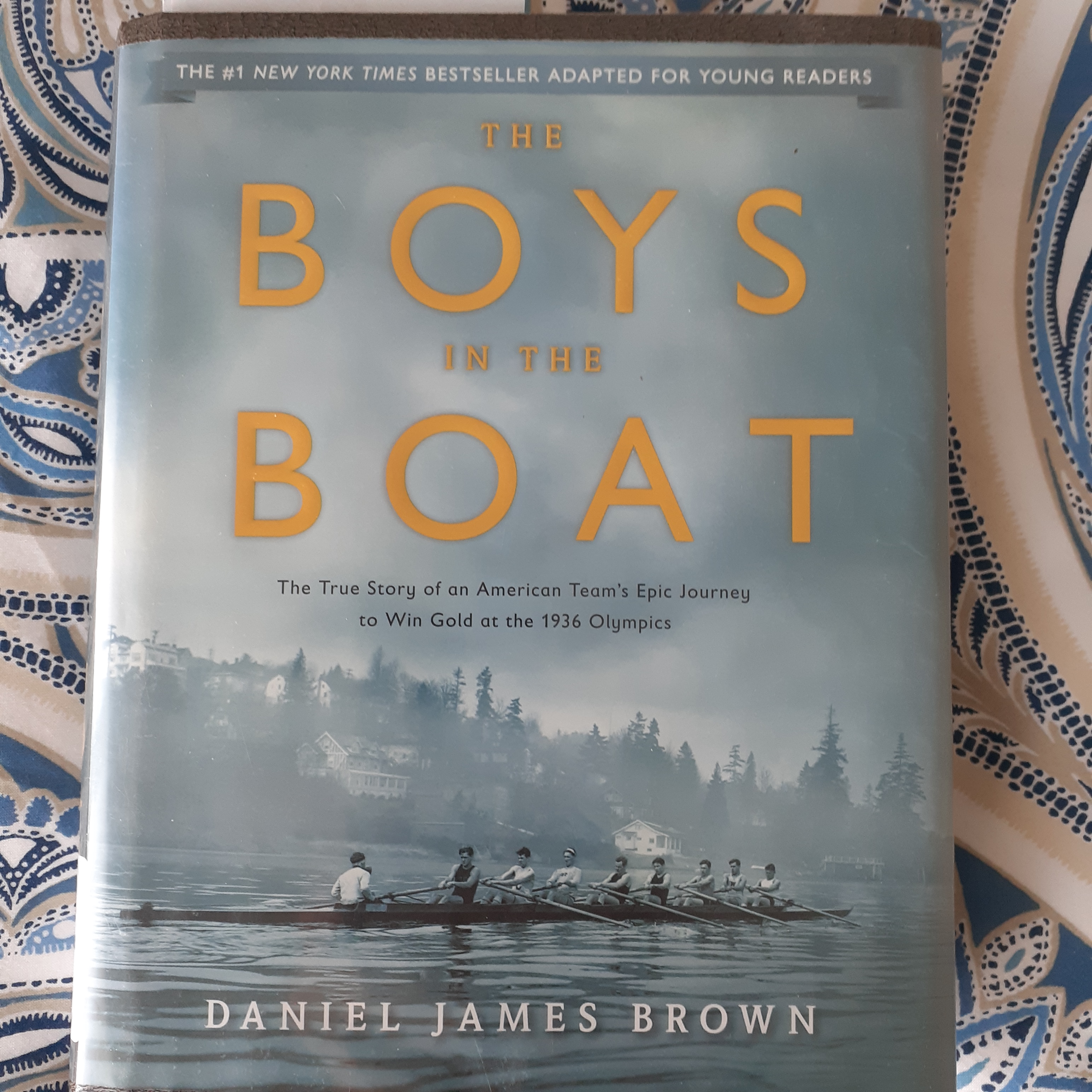
The book follows the hard tack life of Joe Rantz, and eight other working-class boys from the American West. Brown, in “A NOTE FROM THE AUTHOR,” writes, “So as you read this book, I hope you will keep in mind that at its heart this is a story about growing up, about wrestling with hope and doubt, about dreaming big, about going for gold. In that sense, it’s really a story about you.”
The story makes one dig deeper into the past. Reflect on how individuals and families coped with the Great Depression. How lessons from the past hold up hope for us not just for today but also for tomorrow. How we can pursue healing for society and ourselves.
Brown recounts the almost breathless moment of the end of the race: “On the balcony of Haus West, Hitler turned and strode back into the building, unspeaking. His henchmen scurried in behind him. The American boys did not understand the announcement at first. But when they did, their grimaces of pain turned suddenly into broad smiles.”
Brown continues: “The next day, the boys prepared the Husky Clipper for shipment back to Seattle, put on their Olympic dress uniforms, and headed to the grand Olympic Stadium in Berlin. After the gold medal soccer match between Austria and Italy, the boys took to the field to receive their medals. As they lined up next to the German and Italian crews, Olympic officials went down the American line, hanging gold medals around the boys’ necks and placing small laurel wreaths on their heads. . .. By the time it was over, they were all fighting back tears.”
Epilogue: “Within days of the closing ceremony of the 1936 Olympics, the Nazis renewed their persecution of German Jews and others they deemed inferior. The anti-Semitic signs returned to German streets. The brutality and terror intensified. In December, Hermann Goring met privately with a number of German business leaders and said, ‘We are already at war. All that is lacking is the actual shooting.’
“The larger world knew little of these war plans. The illusion surrounding the Olympic Games was complete, the deception masterful. Hitler, Goebbels, and the rest had convinced the world that this new Germany was an advanced, civilized culture. But just three years later, by September 1939, the illusion had utterly fallen away. Hitler invaded Poland and the most catastrophic war in world history was under way. In the next five years, it would take the lives of between fifty and sixty million people. So many died that the exact number would never be known.”
Civil Rights Movement
The AARP Bulletin (January/February 2024), tells the stories of a few of the thousands of champions who dared to put their lives on the line during the era of change that was the Civil Rights Movement in the United States. Here are two:
Willie Pearl Mackey King, worked from 1962-66 as a member of Martin Luther King Jr.’s executive staff. She typed King’s “Letter from Brimingham Jail.” She said, “If people read that letter today, they will understand what Dr. King was doing in Birmingham and why he was fighting so hard for civil rights. In my opinion, none of his speeches or writings will give you a clearer vision of his mission.”
Charles Person was one of the Freedom Riders (to draw attention to the continued illegal segregation on interstate buses and in bus terminals). The group endured beatings; the perpetrators not charged by an all-white jury. “Whenever I have the chance to speak to young people, I tell them they can change the world. I hope they listen to anyone who tells them they have the power to make the world a better place.”
Deep freeze, winter’s delight


Invigorating
I used to do a New Year’s Day plunge. Five years running. Ran into the lake, submerged, raced out, freeze- and towel-dried, enjoyed hot drinks and snacks. The first year the host had a priest come out and sprinkle us with holy water. That was once upon a time, a good few years ago.
Invigorating is the word that describes the sensation from such a plunge.
I’m happy that people around the world find ice-bathing invigorating. I can live vicariously in their pursuits. I’ve no compulsion to prove I could still do it. The thought itself is invigorating enough.
An invigorating dip into what helps you thrive all winter long. May we find soul-stirring moments all along the way.
-John
 It's About Now
I can’t imagine that cold plunge! although in the summertime I do enjoy cold showers. Invigorating.
LikeLike